
Publishing Scholarly Archaeology since 1997
Publishing Scholarly Archaeology since 1997
Log in | My Account | Basket Twitter Facebook LinkedIn
Advanced Search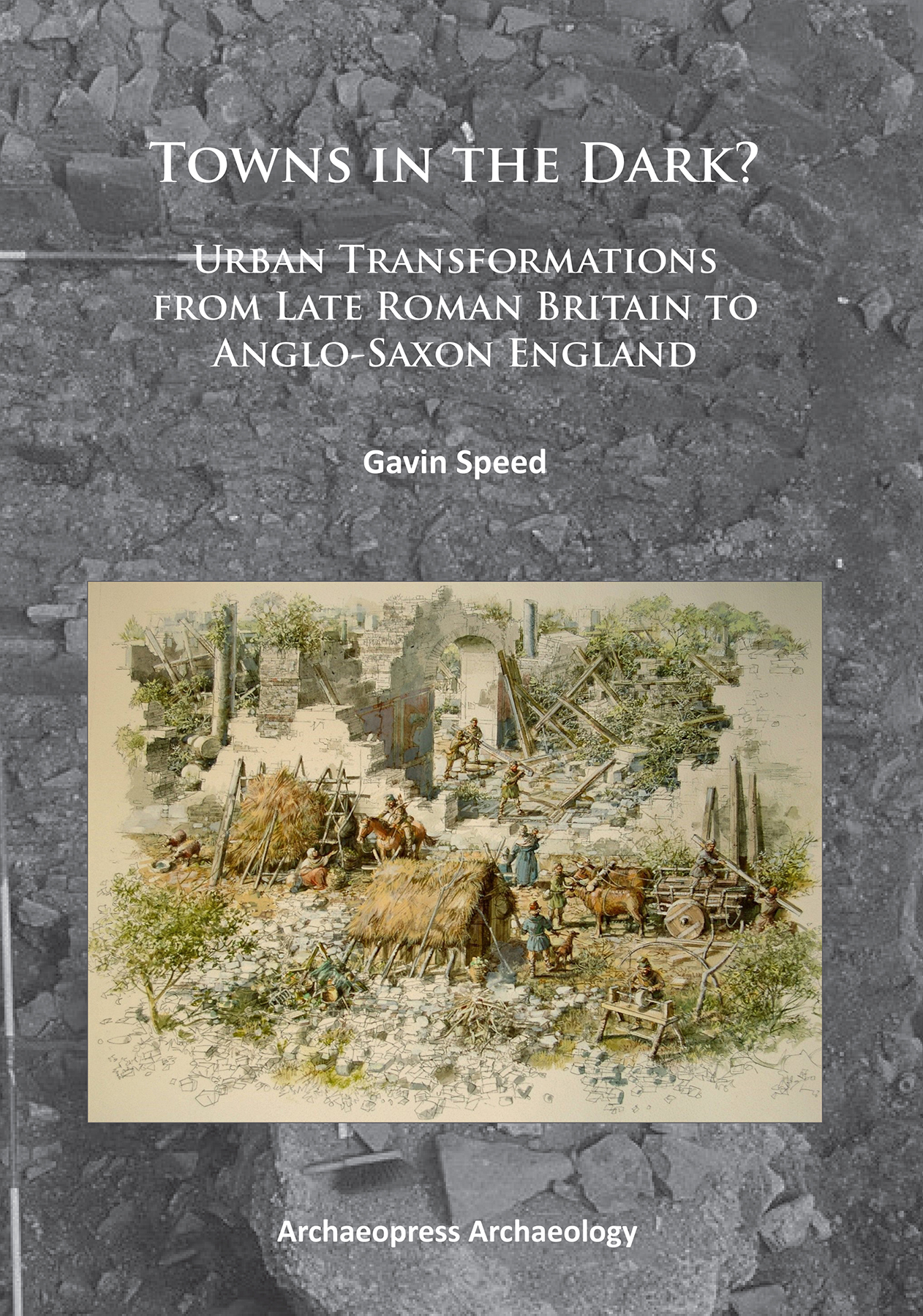
Download Sample PDF
H 297 x W 210 mm
204 pages
illustrated throughout in black and white
Published Jul 2014
ISBN
Paperback: 9781784910044
Digital: 9781784910051
Towns in the Dark
Urban Transformations from Late Roman Britain to Anglo-Saxon England
By Gavin Speed

Paperback
£34.00 £22.10
Includes PDF
PDF eBook
(personal use)
£16.00
PDF eBook
(institutional use)
£34.00
 Add to wishlist
The focus of this book is to draw together still scattered data to chart and interpret the changing nature of life in towns from the late Roman period through to the mid-Anglo-Saxon period. Did towns fail? Were these ruinous sites really neglected by early Anglo-Saxon settlers and leaders?
Contents
Acknowledgements
Preface
Chapter 1: Introduction and Methodology
Research Background
Research Aims and Questions
Structure of the Book
Data Sources
Methodology
Chapter 2: A Review of Debate on Romano-British Towns, AD 300 – 600
Introduction
Early Pioneers: Haverfield, Wheeler, and Collingwood
The Urban Archaeology of Frere, Wacher, and Biddle
Divergent Views and Romanisation
Polarised Visions: Dark and Faulkner
New Century: New Viewpoints?
The Future
Chapter 3: Urban Sequences in the South-East
Introduction
London
Colchester
Canterbury
Summary
Chapter 4: Urban Sequences in the South-West
Introduction
Cirencester
Winchester
Silchester
Summary
Chapter 5: Urban Sequences in the Midlands
Introduction
Leicester
Lincoln
Wroxeter
Summary
Chapter 6: Questioning Towns in Late Roman Britain: Forms, Functions, and Failings
Introduction
Defining Late Romano-British Urbanism
Urban Roles and Authorities: Controls and Taxation
Monumental or Ruinous? Changing Public Services
Population Profiles: Town and Country
Provincial Urbanisms: Beyond Britannia
Summary: Town Life at the End of Roman Britain
Chapter 7: Towns as Settlements, or as Symbols of the Past? 5th- and 6th- Century England
Introduction
Models of Change I: Sub-Roman ‘Urbanism’
Models of Change II: Anglo-Saxon Ruralised Nuclei
Models of Change III: Failure and Shift
Identifying the People of the 5th and 6th Centuries AD
Re-emergences beyond AD 600
Summary: What Role for ‘Towns’ in a Ruralised Society?
Chapter 8: Stepping out from the Dark: Conclusions and Directions
Introduction
Defining Urban Transformations: AD 300 - 600
Debating Urban Transformations: East and West, Worlds Together or Worlds Apart?
Research Achievements
Remaining Issues
New Routes, Research, and Directions
Concluding Remarks: What is New?
Appendices
Appendix 1: Case Studies Data
Appendix 2: Additional Data
Bibliography
Reviews
'The author has brought his experience and skill as a field archaeologist and urban excavator to bear on an ambitious subject. He seeks to explore the evidence for occupation, function and role of urban places during the fourth to sixth centuries and attempts to understand how and why these roles and functions may have changed. The result is a generally impressive marshalling of evidence, some of which is obscurely published or unpublished. Speed deserves to be congratulated for bringing this information — the results of countless commercially-funded urban excavations — to the attention of a wider audience… The volume is handsomely produced and richly illustrated.' - James Gerrard (2015): Britannia

Archaeopress Publishing Ltd
First and Second Floor
13-14 Market Square
Bicester
Oxfordshire OX26 6AD
United Kingdom
Tel +44 (0) 1865 311914 | fax +44 (0) 1865 512231 | email info@archaeopress.com
