
Publishing Scholarly Archaeology since 1997
Publishing Scholarly Archaeology since 1997
Log in | My Account | Basket Twitter Facebook LinkedIn
Advanced Search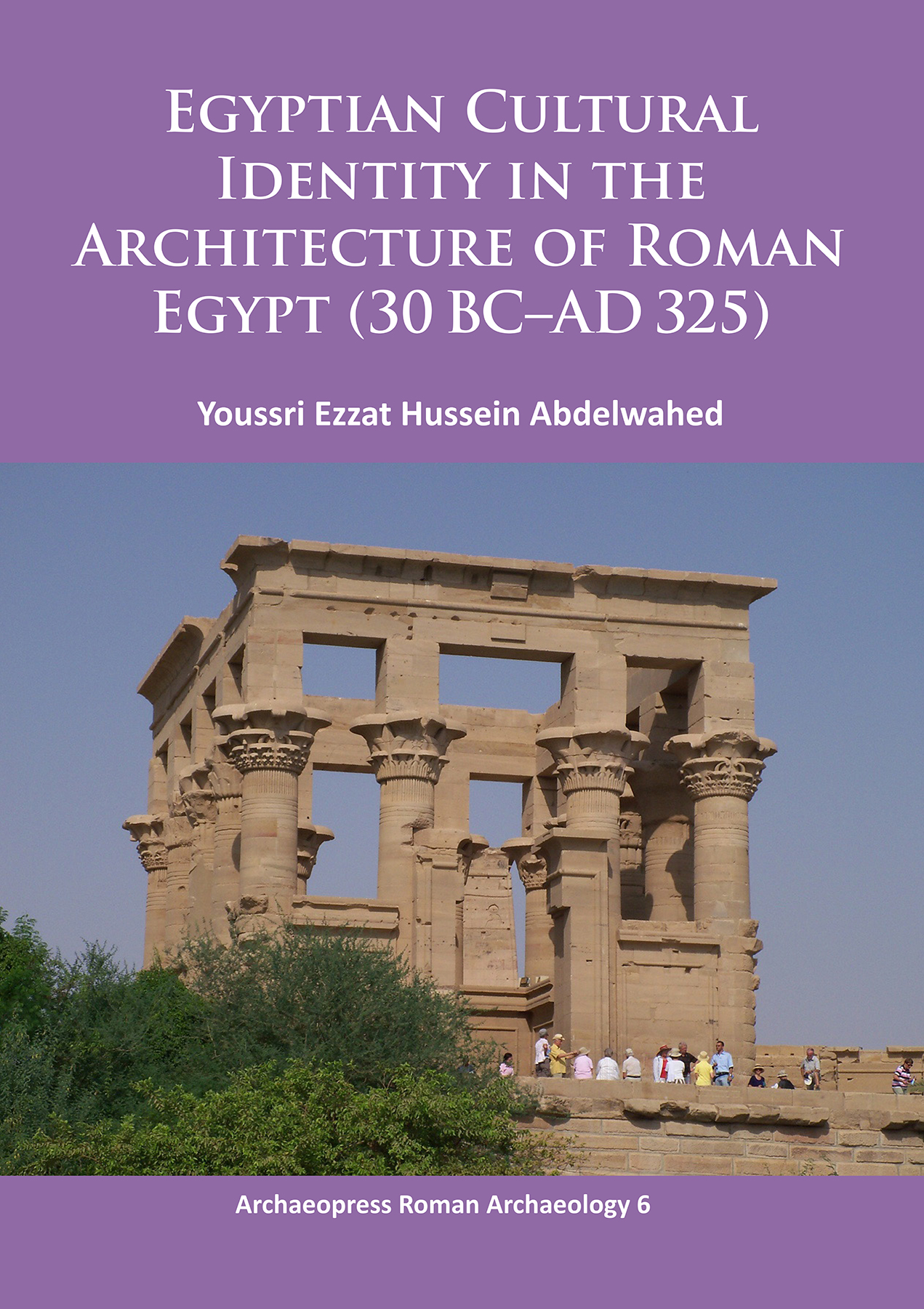
Download Sample PDF
H 297 x W 210 mm
236 pages
Illustrated throughout in black & white
Published Feb 2015
ISBN
Paperback: 9781784910648
Digital: 9781784910655
Archaeopress Roman Archaeology 6
Egyptian Cultural Identity in the Architecture of Roman Egypt (30 BC-AD 325)
By Youssri Ezzat Hussein Abdelwahed

Paperback
£37.00 £24.05
Includes PDF
PDF eBook
(personal use)
£16.00
PDF eBook
(institutional use)
£37.00
 Add to wishlist
This volume considers the relationship between architectural form and different layers of identity assertion in Roman Egypt. It stresses the sophistication of the concept of identity, and the complex yet close association between architecture and identity.
Contents
Note to the Reader
List of Abbreviations
Acknowledgments
Introduction
Chapter I: City Layout, Urban Space, and Public Buildings
The city: a ‘site of display’ of identity
Architectural diversity and the complexity of identity
Greek poleis
Metropoleis
Conclusion
Chapter II: Monumentality of the Pylon and Egyptian Cultural Identity
Monumental architecture and identity
The design and name of the pylon
The pylon: an epitome of Egyptian culture and its religious architecture
The symbolism of the pylon
The ritual of ‘the coronation of the sacred falcon’
Roman-period pyla: visual and textual evidence
The pylon depicted on the palestrina mosaic
Pyla depicted on coins minted at Roman Alexandria
Conclusion
Chapter III: Houses and Egyptian Cultural Identity
Approaching the Romano-Egyptian house
The internal division of houses
Ritual activities enacted before the front door of houses
Ritual activities enacted within houses
Conclusion
Chapter IV: Tomb Iconography and Egyptian Cultural Identity
Funerary art in Roman Egypt: the current situation
Image and text: complementarity and interchangeability
Roman-period tombs at Alexandria
Roman-period tombs in the chora
The ‘double style’, hybridization, and biculturalism in funerary art
Ethnicity, culture, and identity in tomb iconography
Conclusion
Chapter V: Architectural Ornament and Egyptian Cultural Identity
Ornamental style and identity
Architectural ornament and Egyptian cultural identity
The cavetto cornice and torus moulding
Egyptian composite capitals
Conclusion
General Conclusion
Maps
Plates
Appendix 1: Catalogue of Roman-Period Temple Pyla
Appendix 2: Catalogue of Roman-Period Houses
Appendix 3: Catalogue of Roman-Period Tombs
Appendix 4: Typology of Eyptian Composite Capitals
Bibliography
Archaeopress Publishing Ltd
First and Second Floor
13-14 Market Square
Bicester
Oxfordshire OX26 6AD
United Kingdom
Tel +44 (0) 1865 311914 | fax +44 (0) 1865 512231 | email info@archaeopress.com
