
Publishing Scholarly Archaeology since 1997
Publishing Scholarly Archaeology since 1997
Log in | My Account | Basket Twitter Facebook LinkedIn
Advanced Search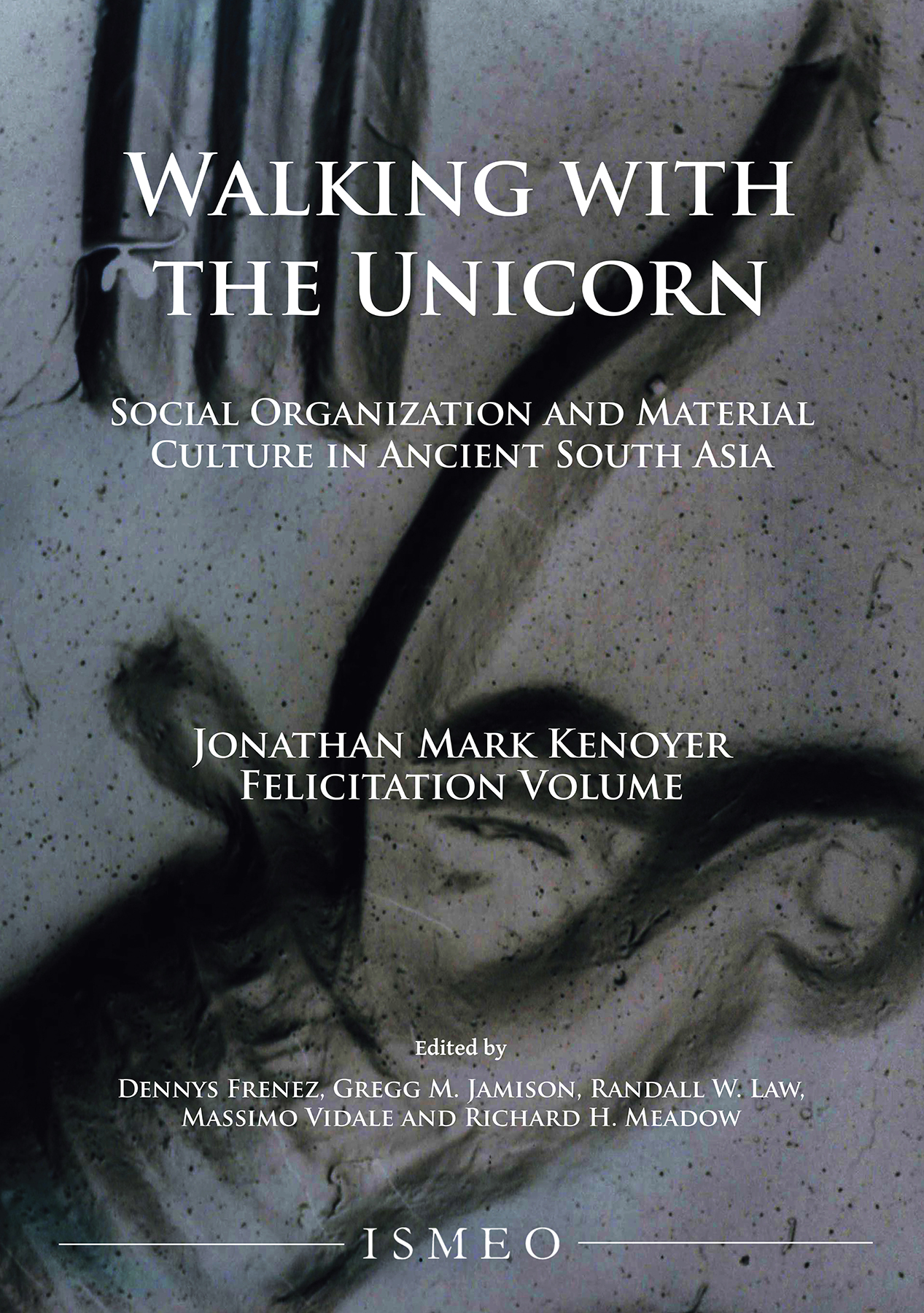
Download Sample PDF
H 290 x W 205 mm
666 pages
Highly illustrated throughout in colour and black & white
Published Aug 2018
ISBN
Paperback: 9781784919177
Digital: 9781784919184
Keywords
Archaeology; South Asia; Bronze Age; Indus; Mark Kenoyer; Festschrift
Walking with the Unicorn: Social Organization and Material Culture in Ancient South Asia
Jonathan Mark Kenoyer Felicitation Volume
Edited by Dennys Frenez, Gregg M. Jamison, Randall W. Law, Massimo Vidale, Richard H. Meadow

Paperback
£110.00
Includes PDF
PDF eBook
(personal use)
£16.00
PDF eBook
(institutional use)
£110.00
 Add to wishlist
This volume, a compilation of original papers written to celebrate the outstanding contributions of Jonathan Mark Kenoyer to the archaeology of South Asia over the past forty years, highlights recent developments in the archaeological research of ancient South Asia, with specific reference to the Indus Civilization.
Contents
Jonathan Mark Kenoyer and ISMEO ??? Occasions in Continuum (Adriano V. Rossi) ;
Jonathan Mark Kenoyer ??? The Tale of Sikander and the Unicorn (Dennys Frenez, Gregg Jamison, Randall Law, Massimo Vidale and Richard H. Meadow) ;
Jonathan Mark Kenoyer ??? Bibliography ;
Fish Exploitation during the Harappan Period at Bagasra in Gujarat, India. An Ichthyoarchaeological Approach (Abhayan G. S., P. P. Joglekar, P. Ajithprasad, K. Krishnan, K. K. Bhan and S. V. Rajesh) ;
The Sincerest Form of Flattery? Terracotta Seals as Evidence of Imitation and Agency in Bronze Age Middle Asia (Marta Ameri) ;
Reflections on Fantastic Beasts of the Harappan World. A View from the West (Joan Aruz) ;
Fish Symbolism and Fish Remains in Ancient South Asia (William R. Belcher) ;
Some Important Aspects of Technology and Craft Production in the Indus Civilization with Specific Reference to Gujarat (Kuldeep K. Bhan) ;
Chert Mines and Chert Miners. The Material Culture and Social Organization of the Indus Chipped Stone Workers, Artisans and Traders in the Indus Valley (Sindh, Pakistan) (Paolo Biagi, Elisabetta Starnini and Ryszard Michniak) ;
Ceramic Analysis and the Indus Civilization. A Review (Alessandro Ceccarelli and Cameron A. Petrie) [Open Access: Download] ;
Family Matters in Harappan Gujarat (Brad Chase) ;
Revisiting the Ornament Styles of the Indus Figurines: Evidence from Harappa, Pakistan (Sharri R. Clark) ;
The Harappan ???Veneer??? and the Forging of Urban Identity (Mary A. Davis) ;
Private Person or Public Persona? Use and Significance of Standard Indus Seals as Markers of Formal Socio-Economic Identities (Dennys Frenez) ;
Lithic Blade Implements and their Role in the Harappan Chalcolithic Cultural Development in Gujarat (Charusmita Gadekar and P. Ajithprasad) ;
Who Were the ???Massacre Victims??? at Mohenjo-daro? A Craniometric Investigation (Brian E. Hemphill) ;
Indus Copper and Bronze: Traditional Perspectives and New Interpretations (Brett C. Hoffman) ;
A Short Note on Strontium Isotope Analysis of Human Skeletal Remains from the Site of Sarai Khola (Asma Ibrahim) ;
The Organization of Indus Unicorn Seal Production. A Multi-faceted Investigation of Technology, Skill, and Style (Gregg M. Jamison) ;
The Size of Indus Seals and its Significance (Ayumu Konasukawa and Manabu Koiso) ;
The Art and Technology of Reserving a Slip. A Complex Side of Indus Ceramic Tradition (K. Krishnan and Sneh Pravinkumar Patel) ;
The Art of the Harappan Microbead ??? Revisited (Randall W. Law) ;
The North Gujarat Archaeological Project ??? NoGAP. A Multi-Proxy and Multi-Scale Study of Long-Term Socio-Ecological Dynamics (Marco Madella, P. Ajithprasad, Carla Lancelotti, J. J. Garc??a-Granero, F. C. Conesa, C. Gadekar and S. V. Rajesh) ;
Toponyms, Directions and Tribal Names in the Indus Script (Iravatham Mahadevan and M. V. Bhaskar) ;
Ganweriwala ??? A New Perspective (Farzand Masih) ;
Personal Reflections on some Contributions of Jonathan Mark Kenoyer to the Archaeology of Northwestern South Asia (Richard H. Meadow) ;
Invisible Value or Tactile Value? Steatite in the Faience Complexes of the Indus Valley Tradition (Heather M.-L. Miller and Jonathan Mark Kenoyer) ;
What Makes a Pot Harappan (Heidi J. Miller) ;
Dilmun-Meluhhan Relations Revisited in Light of Observations on Early Dilmun Seal Production during the City IIa-c Period (c. 2050-1800 BC) (Eric Olijdam and H??l??ne David-Cuny) ;
Unicorn Bull and Victory Parade (Asko Parpola) ;
Analytical Study of Harappan Cop
About the Author
Jonathan Mark Kenoyer (born May 28th 1952 in Shillong, India) is one of the world???s leading experts on the ancient Indus Civilisation of Pakistan and India. Professor of Anthropology at the University of Wisconsin ??? Madison, he has been excavating with the Harappa Archaeological Research Project (HARP) at the ancient Indus city of Harappa since 1986 and is currently involved in ongoing research in South Asia as well as in adjacent regions including the Oman Peninsula, Afghanistan and China. His particular interests include the origins and development of urbanism, writing and technologies. He has worked with craftspeople in Pakistan, India, China and the Sultanate of Oman, to replicate ancient pottery, jewellery, copper smelting and other manufacturing processes. He speaks fluently Urdu, Hindi and Bengali.
Archaeopress Publishing Ltd
First and Second Floor
13-14 Market Square
Bicester
Oxfordshire OX26 6AD
United Kingdom
Tel +44 (0) 1865 311914 | fax +44 (0) 1865 512231 | email info@archaeopress.com
