
Publishing Scholarly Archaeology since 1997
Publishing Scholarly Archaeology since 1997
Log in | My Account | Basket Twitter Facebook LinkedIn
Advanced Search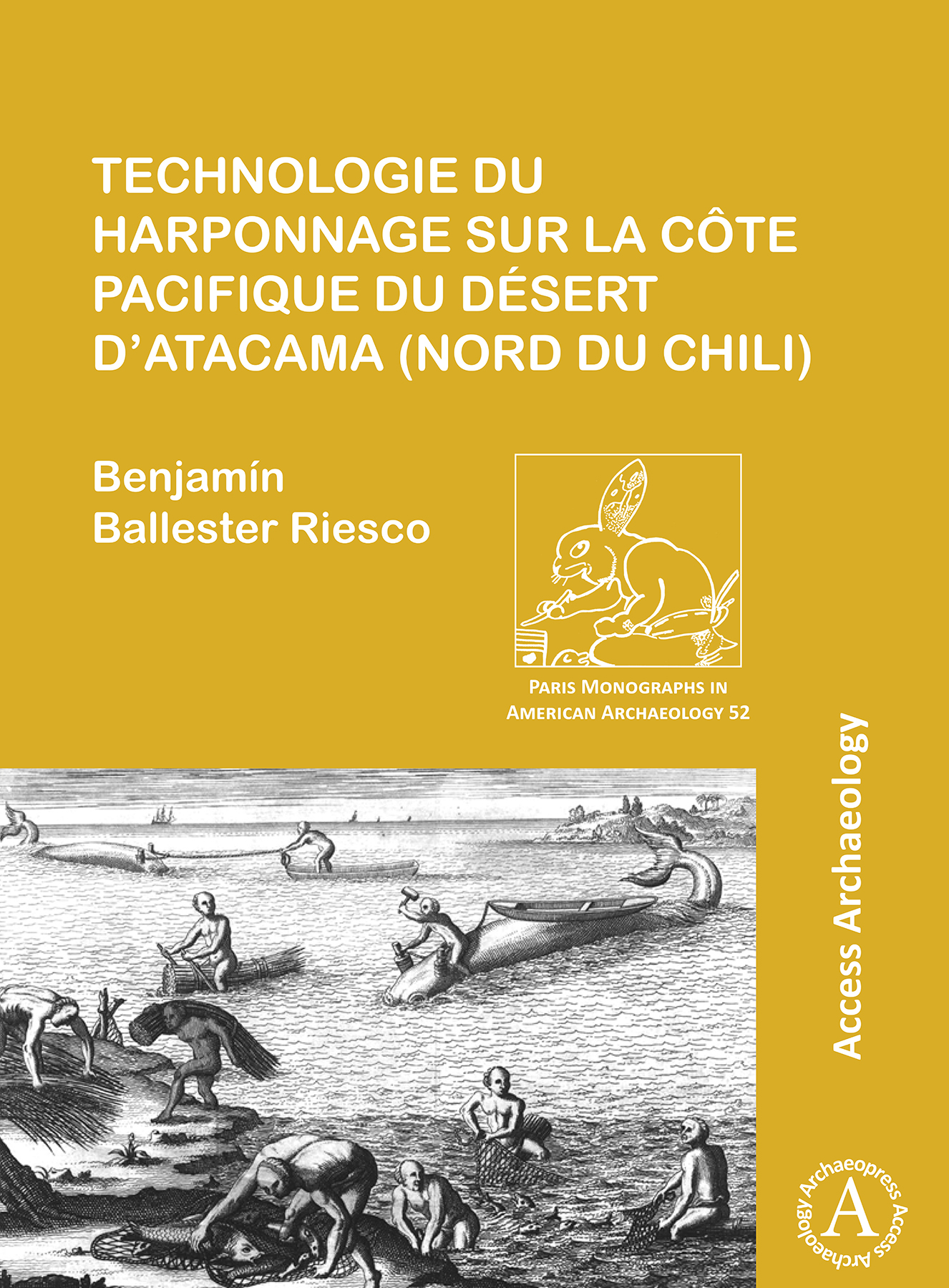
Download Sample PDF
H 276 x W 203 mm
78 pages
Illustrated throughout in colour and black & white (25 plates in colour)
French text
Published Nov 2018
Archaeopress Access Archaeology
ISBN
Paperback: 9781789690279
Digital: 9781789690286
Keywords
Chile; Prehistory; Early Man; Harpoon; Hunter-Gatherer
Paris Monographs in American Archaeology 52
Technologie du harponnage sur la c??te Pacifique du d??sert d???Atacama (nord du Chili)

Paperback
£28.00
Includes PDF
PDF eBook
(personal use)
Free Download
PDF eBook
(institutional use)
£10.00
 Add to wishlist
Throughout the volume the reader will follow a representation of a marine hunter-gatherer society, a projection deriving from one of its iconic and most important material assets, the harpoon.
Contents
Pr??logo; Introduction; Harponnage et chasse marine; Ant??c??dents historiques sur la chasse marine dans le d??sert d???Atacama; Probl??matique; Typologie; Aspects conceptuels et m??thodologiques 25; Univers et corpus d?????tude; R??sultats; Synth??se; Conclusion; Perspectives Futures; R??f??rences Bibliographiques; Annexe 1 S??quence historique de la c??te du d??sert d???Atacama; Annexe 2 Tableau g??n??ral des variantes pour chaque attribut technologique de la t??te du harpon
About the Author
Benjam??n Ballester is an archaeologist from the University of Chile and holds a Masters in Pr??histoire et Protohistoire from the Universit?? Paris 1 Panth??on Sorbonne, France. Currently he is a Contractual Doctoral student at the same French University. He is specialist in the study of American littoral societies, particularly of those who inhabited the Atacama coast in northern Chile, and also researches their history. His investigations focus on anthropology, ethnography, history and archaeology, and are characterized by a multi-disciplinary approach from the social and human sciences. Art, navigation, technology, economy, politic and social practices are some of the principal interest topics. | Arch??ologue de l???Universit?? de Chili et Master en Pr??histoire et Protohistoire de l???Universit?? Paris 1 Panth??on Sorbonne en France. Actuellement il est Doctorante Contractuel de la m??me Universit?? fran??aise. Il s???est sp??cialis?? en l?????tude des soci??t??s littorales am??ricaines, particuli??rement sur celles qui habitaient des c??tes d???Atacama, au nord du Chili, au long de leur histoire. Ses recherches tournent autour de l???anthropologie, l???ethnographie, l???histoire et l???arch??ologie, caract??ris??e par une approche multidisciplinaire depuis les sciences sociales et humaines. L???art, la navigation, la technologie, l?????conomie, la politique et les pratiques sociales sont leurs principales th??matiques d???int??r??t. | Arque??logo de la Universidad de Chile y Master en Pr??histoire et Protohistoire de la Universit?? Paris 1 Panth??on Sorbonne de Francia. Actualmente es Doctorante Contractual de la misma universidad francesa. Se ha especializado en el estudio de las sociedades litorales americanas, particularmente en las que habitaron en las costas de Atacama, al norte de Chile, a lo largo de la historia. Sus investigaciones deambulan entre la antropolog??a, etnograf??a, historia y arqueolog??a, caracteriz??ndose por una aproximaci??n multidisciplinaria desde las ciencias sociales y humanidades. El arte, la navegaci??n, la tecnolog??a, la econom??a, la pol??tica y las pr??cticas sociales son sus principales temas de inter??s.
Archaeopress Publishing Ltd
First and Second Floor
13-14 Market Square
Bicester
Oxfordshire OX26 6AD
United Kingdom
Tel +44 (0) 1865 311914 | fax +44 (0) 1865 512231 | email info@archaeopress.com
