
Publishing Scholarly Archaeology since 1997
Publishing Scholarly Archaeology since 1997
Log in | My Account | Basket Twitter Facebook LinkedIn
Advanced Search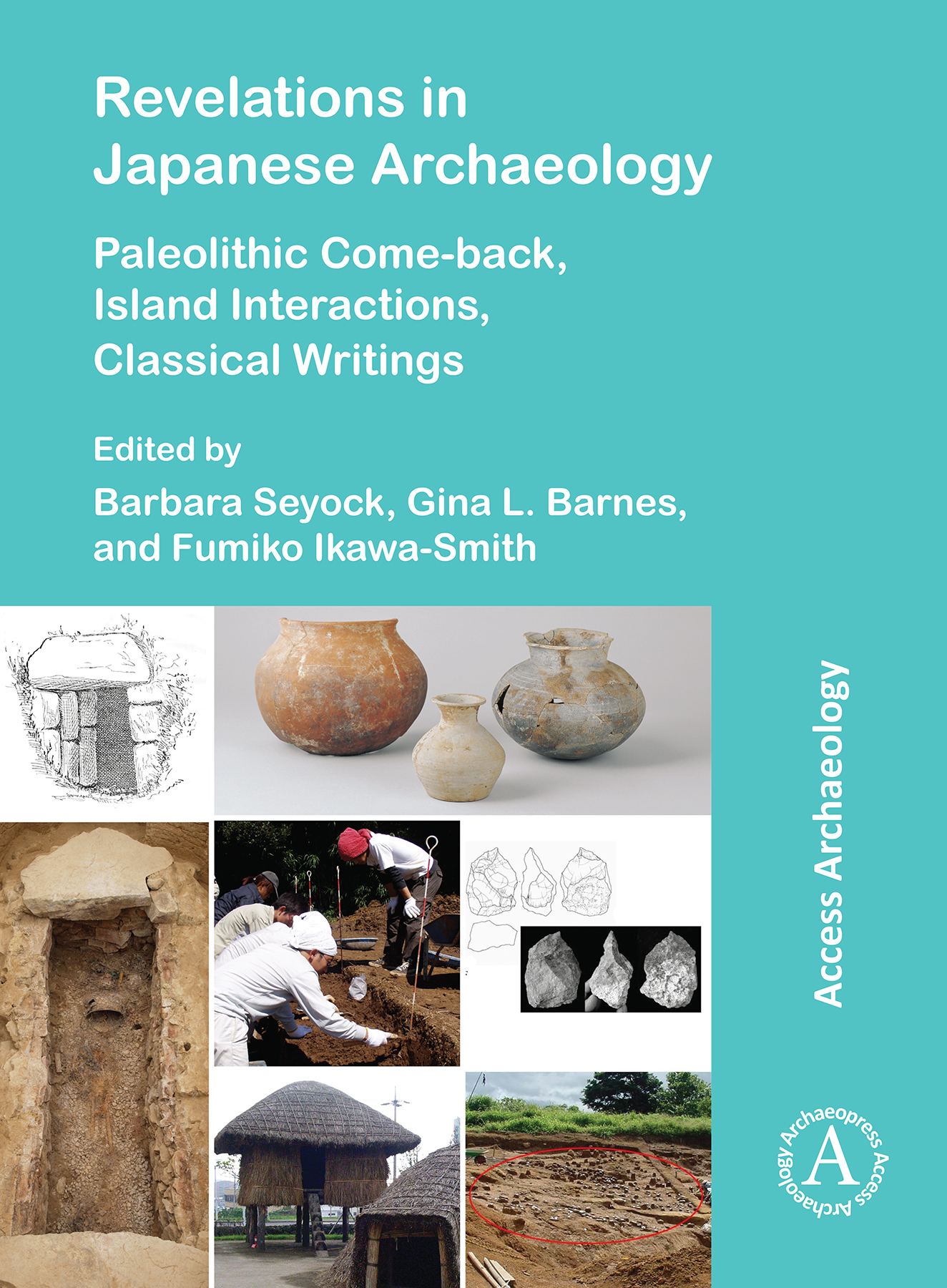
Download Sample PDF
H 276 x W 203 mm
262 pages
157 figures, 6 tables (some colour throughout)
Published Apr 2025
Archaeopress Access Archaeology
ISBN
Paperback: 9781803279855
Digital: 9781803279862
Keywords
Japanese Archaeology; Japan; Early Palaeolithic; Island Interactions; Classical writings
Related titles
Revelations in Japanese Archaeology
Paleolithic Come-back, Island Interactions, Classical Writings
Edited by Barbara Seyock, Gina L. Barnes, Fumiko Ikawa-Smith

Paperback
£55.00 £35.75
Includes PDF
PDF eBook
(personal use)
Free Download
PDF eBook
(institutional use)
£9.99
 Add to wishlist
This volume compiles significant articles from the BSEAA, updated for this volume. It covers the Japanese Paleolithic, protohistoric Yayoi and Kofun periods, and the beginnings of Japanese archaeology, offering new perspectives on cultural transmission, subsistence practices, and centralized societies.
Contents
Preface – By Barbara Seyock and Gina L. Barnes
Part I. The Early Paleolithic in Japan
1. Starting Over Again: Introductory Remarks – by Ikawa-Smith Fumiko ????
2. The Early Paleolithic Industry at Sozudai Site, Oita Prefecture – by Yanagida Toshio ???
3. Lithic Assemblage from the Lowest Layer of Ono Site, Hitoyoshi, Southern Kyushu – by Wada Yoshifumi ????
4. Investigation of the Kanedori Site in Iwate Prefecture, Northern Honshu – by Kuroda Atsushi ????, Kikuchi Kyoichi ????, Komukai Hiroaki ????, and Takeda Yoshio ????
5. Research Progress and Methodological Contribution of Sunabara Site: from sedimentological excavation to phenocryst microscopic observation method – by Uemine Atsushi ???? and Matsufuji Kazuto ????
6. Recent Research on the Early and Middle Paleolithic in Japan: an overview – by Sato Hiroyuki ????
Part II. Island Interactions and Socio-Political Development
7. Introduction to Island Interactions in the Protohistoric Period – by Gina L. Barnes and Barbara Seyock
8. A Comment on the Yayoi Period Dating Controversy – by Shoda Shin’ya ????
9. Karakami—A Yayoi Site on Iki Island – by Jane Oksbjerg
10. Prehistoric Interaction between the Korean Peninsula and the Japanese Archipelago through Tsushima and Iki Islands – by Miyamoto Kazuo ????
11. Tsushima as ‘Boundary’ – by Tawara Kanji ???
12. Jeju Island as a Case Study in Ancient Island-Mainland Interaction – by Barbara Seyock
13. Changes in the Spatial Distribution of Obsidian from Kozushima in the Yayoi Period – by Sugiyama Cohe ????
14. Archaeological Research in Semporna, Sabah, Malaysia – by Stephen Chia
15. The Change in the Distribution System of Bronze Mirrors at the Beginning of Kofun period Japan: as seen from fragmented bronze mirrors – by Tsujita Jun’ichiro ?????
16. The 2007 Excavation at Shobuzako Kofun – by Jane Oksbjerg
Part III. Classical Western Writings on Japanese Archaeology and Anthropology
17. Comments on Two Essays on Japanese Archaeology written by Edward S. Morse – by Michael Moos
18. Traces of an Early Race in Japan, by Edward S. Morse reprint, annotations – by Michael Moos
19. Dolmens in Japan, Edward S. Morse reprint, annotations – by Michael Moos
About the Author
Barbara Seyock is a specialist in trade and exchange in prehistoric and historical East Asia. She received her doctorate in 2003 from the University of Tübingen on the archaeology and history of the "Eastern Barbarians" (proto-historical cultures in Korea and Japan). Her research focuses on early cultural transfer around the Korea Strait as well as trade and maritime exchange in pre-modern times in East and Southeast Asia.She has lectured on East Asian archaeology at the Dept. of Archaeology, Ruhr-University of Bochum and was a member of the VW-Project on “the East Asian Mediterranean” at Munich University.
Gina L. Barnes, PhD Michigan 1983. Taught East Asian Archaeology at Cambridge University 1981-1995 and at Durham University 1996-2006. She founded the East Asian Archaeology Network in 1990, which became the Society for East Asian Archaeology in 1996, serving as the first President (1996-1998). Her publications include State Formation in Korea (Routledge 2001), State Formation in Japan (2006), East Asian Archaeology (Routledge, 2015), TephroArchaeology (ed. with SODA Tsutomu, Archaeopress 2019), and Tectonic Archaeology (Archaeopress 2022).
Born in Japan, Fumiko Ikawa-Smith began her study of Anthropology in the USA as a Fulbright exchange student at Harvard University. She received doctorate in 1974 with a dissertation on the Early Palaeolithic cultures of Japan. It has remained the focus of her research interest, as she explored such topics as food and nutrition, gender in prehistory, and social contexts of archaeology. She is a co-founder of the Japan Studies Association of Canada, and served as its President three times.
Archaeopress Publishing Ltd
First and Second Floor
13-14 Market Square
Bicester
Oxfordshire OX26 6AD
United Kingdom
Tel +44 (0) 1865 311914 | fax +44 (0) 1865 512231 | email info@archaeopress.com
