
Publishing Scholarly Archaeology since 1997
Publishing Scholarly Archaeology since 1997
Log in | My Account | Basket Twitter Facebook LinkedIn
Advanced Search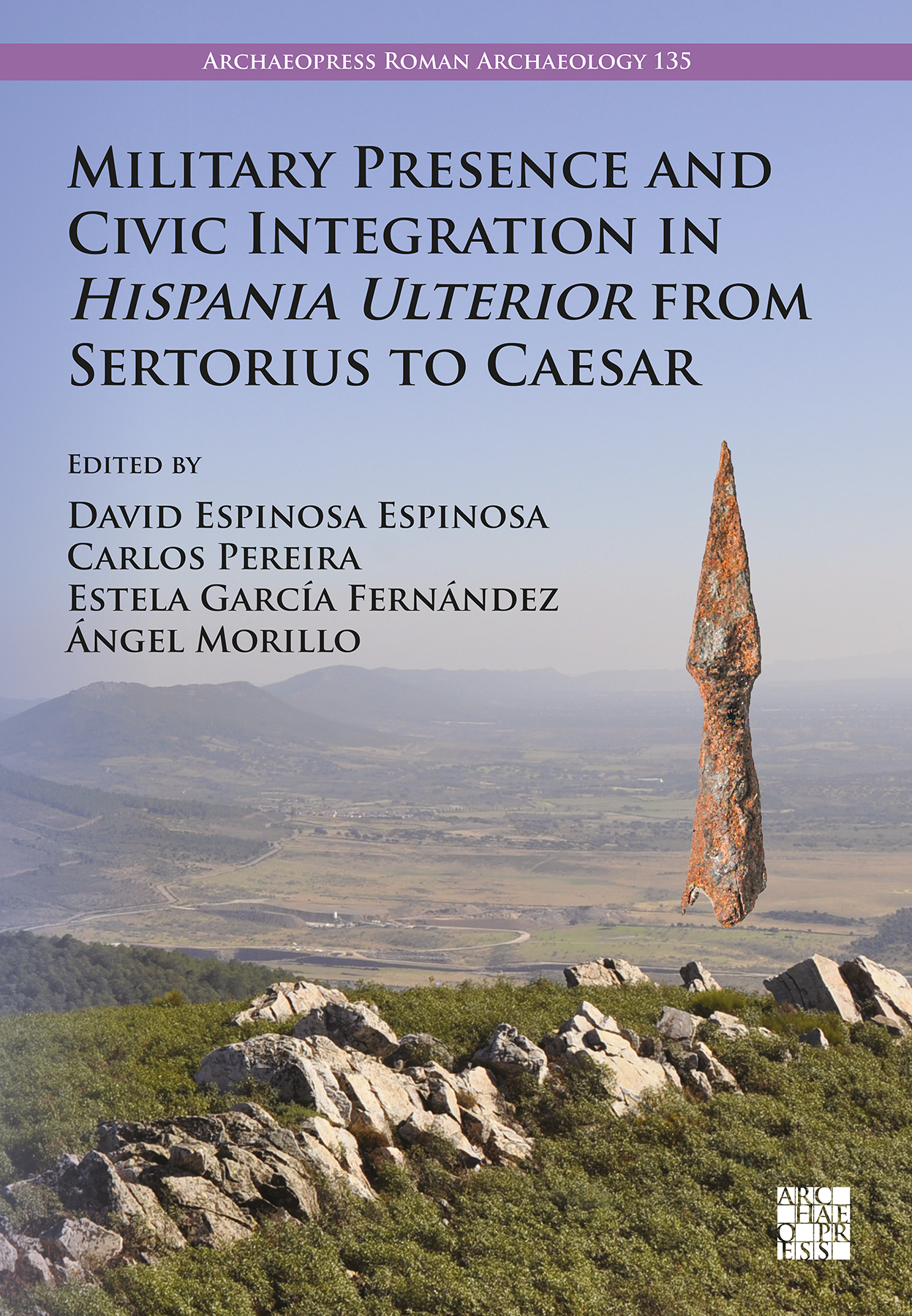
Download Sample PDF
H 290 x W 205 mm
204 pages
74 figures (colour throughout)
Published Dec 2025
ISBN
Paperback: 9781805832119
Digital: 9781805832126
Keywords
Roman army; Hispania Ulterior; 1st century BCE; Civic Integration; Cultural Transfer
Related titles
Archaeopress Roman Archaeology 135
Military Presence and Civic Integration in Hispania Ulterior from Sertorius to Caesar
Edited by David Espinosa Espinosa, Carlos Pereira, Estela García Fernández, Ángel Morillo

Paperback
£48.00
Includes PDF
PDF eBook
(personal use)
£16.00
PDF eBook
(institutional use)
£48.00
 Add to wishlist
This book reassesses Roman activity in Hispania Ulterior (1st c. BC), exploring military conflicts, archaeological evidence, and civic integration from Sertorius to Caesar. It highlights provincial agency and the dynamic processes shaping identity, loyalty, and urban landscapes under Rome.
Contents
Preface ??? David Espinosa Espinosa, Carlos Pereira, Estela Garc??a Fern??ndez and ??ngel Morillo
??
I ??? MILITARY CONFLICT IN HISPANIA ULTERIOR
1. From Viriathus to Sertorius: The River Tagus region as a ???middle ground??? in Roman expansion in Hispania Ulterior. Some open questions ??? Eduardo S??nchez Moreno
2. The Late Republican legionary fortress at C??ceres el Viejo (C??ceres, Spain). Q. Caecilius Metellus??? strategic axis against Sertorius ??? ??ngel Morillo and Carlos Pereira
3. Western coin hoards and other coin finds between the Douro and Tagus rivers as evidence of Roman occupation and control during the 1st century BC: Gold as the objective ??? Cruces Bl??zquez Cerrato
4. Following in the footsteps of Julius Caesar: A Caesarian battlefield in Ulia (Montemayor, C??rdoba, Spain) ??? Fernando Quesada Sanz, Javier Moralejo Ordax, Jes??s Robles Moreno and Pablo S. Harding Vera
??
II ??? MILITARY PRESENCE IN HISPANIA ULTERIOR
5. Episodes of war in Lusitania from Sertorius to Caesar: action and reaction ??? Carlos Pereira, ??ngel Morillo and Cruces Bl??zquez Cerrato
6. The Late Republican settlement of Monte Dos Castelinhos (Vila Franca De Xira, Portugal) ??? Jo??o Pimenta
7. Roman Late Republican armament (1st century BC) according to finds in the Iberian Peninsula ??? Carmelo Fern??ndez Ib????ez
8. Amphorae in Roman military and civilian contexts between the Sertorian period and the mid-1st century BC in the Western Iberian Peninsula ??? Rui Morais
9. Imitations of Roman ware and military spaces in Iberia: Republican grey burnished ware (Rgb) ??? Andr??s Mar??a Adroher Auroux
??
III ??? CIVIC INTEGRATION IN HISPANIA ULTERIOR
10. The provincialisation of Hispania and the Socii ex formula togatorum ??? Estela Garc??a Fern??ndez
11. The legal integration of Hispanian and Italic populations in Hispania Ulterior from Sertorius to Caesar: Modalities and historical contexts ??? David Espinosa Espinosa
12. Legal changes and social transformations in the communities of Hispania Ulterior: Caesarian colonisation and its historical implications in the south of the Iberian Peninsula ??? Jos?? Ortiz C??rdoba
13. From Ulterior to Lusitania: new civitates for a new provincial framework ??? Enrique Paredes Mart??n
About the Author
David Espinosa Espinosa is an Associate Professor of Ancient History at the Complutense University of Madrid. His research focuses on Latin rights and Roman citizenship in the western Roman provinces during the Republic and the High Roman Empire, the reevaluation of the Roman civil wars in the Late Roman Republic, and the history of Hispania and Sicily in Roman times.
Carlos Pereira is an Assistant Professor at the University of Valladolid. He has a PhD in History with speciality in Archaeology from the University of Lisbon. His scientific contributions focus on the archaeology of death in Roman times, as well as Roman military archaeology in the western Iberian Peninsula, most recently studying the C??ceres el Viejo camp.
Estela Garc??a Fern??ndez is an Associate Professor of Ancient History and Co-Director of the Research Group ???Ciudades Romanas??? at the Complutense University of Madrid. Her research focuses on the processes of integration of provincial populations in the Roman world and the study of the Intellectual History of Rome.
??ngel Morillo Cerd??n is a Professor of Archaeology at the Complutense University of Madrid. He has a PhD in Archaeology from the Autonomous University of Madrid. His research focuses on the process of Roman settlement in the Iberian Peninsula, especially the presence of the Roman army and the dynamics of cultural transfer.
Archaeopress Publishing Ltd
First and Second Floor
13-14 Market Square
Bicester
Oxfordshire OX26 6AD
United Kingdom
Tel +44 (0) 1865 311914 | fax +44 (0) 1865 512231 | email info@archaeopress.com
